
Geometry Tutor in Denver: Proofs and Problem-Solving
Geometry is often the first math class that feels different. Students who did well in algebra may suddenly feel uncertain because geometry asks them to reason from diagrams, definitions, theorems, and written explanations. Instead of just solving for x, they may need to prove why something is true.
That shift can be frustrating, but it is also fixable. A strong geometry tutor helps students learn the language of the course and the habits that make problems less mysterious.
Why Geometry Trips Students Up
Geometry combines several skills at once. Students need to understand diagrams, track given information, remember vocabulary, apply theorems, write logical steps, and sometimes use algebra inside the problem.
The challenge is not always the math computation. Often the student does not know where to start. They may stare at a diagram and see shapes, but not relationships.
Common sticking points include:
Proofs.
Congruent triangles.
Similarity.
Parallel lines and transversals.
Circles.
Coordinate geometry.
Area, volume, and right-triangle relationships.
Once students learn how to organize information, many geometry problems become much more manageable.
The Proof Problem
Proofs can make even strong students feel lost. The issue is that proofs require a different kind of confidence. Students have to justify each step, not just arrive at an answer.
A tutor can help students build proof habits:
Mark the diagram.
Rewrite the given information.
Identify the goal.
Look for the theorem that connects the given information to the goal.
Work backward when stuck.
Use precise vocabulary.
Proofs become easier when students stop treating them as a guessing game and start treating them as a chain of small claims.
Connecting Geometry Back to Algebra
Geometry is not separate from algebra. Students still solve equations, work with proportions, graph lines, use distance and midpoint formulas, and interpret variables.
When students struggle with a geometry problem, the hidden issue may be algebra. A student may understand similar triangles but make errors solving the proportion. Another student may know the Pythagorean theorem but struggle with radicals.
Good tutoring catches both layers: the geometry concept and the algebra execution.
Building Spatial Reasoning
Some students need help seeing relationships in diagrams. They may miss vertical angles, corresponding parts, radii, angle bisectors, or hidden right triangles. Tutoring can train students to annotate diagrams instead of relying on mental tracking.
Simple habits help:
Use different marks for equal sides and equal angles.
Label what is known.
Draw auxiliary lines when helpful.
Separate the diagram into smaller pieces.
Write equations directly from relationships.
Geometry rewards students who externalize their thinking.
How Tutoring Rebuilds Confidence
Geometry confidence comes from repeated successful starts. Students need to experience the moment of looking at a problem, identifying a relationship, and choosing a path. That is different from watching someone else solve it.
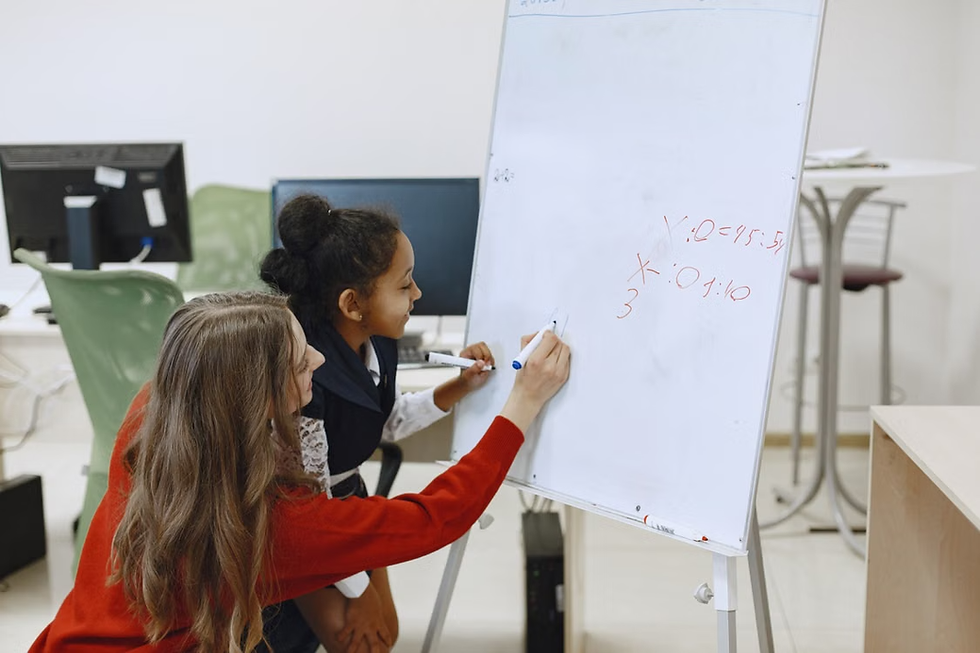
At Flatirons Tutoring, geometry sessions are interactive. Tutors ask students to explain, mark, predict, and justify. Over time, students become more willing to try because they have a process to fall back on.
Work With a Denver Geometry Tutor
If geometry is starting to feel like a wall this fall, support now can prevent months of frustration. With the right approach, students can learn to reason through diagrams, write stronger proofs, and connect geometry back to the math they already know.
Get matched with a Denver Geometry tutor and start progressing towards your academic goals today!
P.S. Check out the different ways to earn FREE tutoring!


Comments